




















 Share
Porcelain stoneware allows working on proportions, surfaces, and volumes, transforming the modern fireplace wall into a true architectural element.
Depending on the desired effect, the cladding can create continuity with floors and furnishings or introduce a material contrast capable of making the fireplace the focal point of the space.
From fireplace cladding to wall design for a designer living space
In many living rooms the fireplace is already the focal point of the room, where the eye is drawn upon entering and around which sofas and furnishings are arranged. Designing the fireplace cladding therefore means considering not only the surface that frames it, but the entire wall on which it is inserted. The fireplace can visually organize the space, interacting with furnishings and living room cladding.
The relationship between the opening of the hearth and the surrounding volume contributes decisively to the final result: a vertical development can accentuate the height of the wall and give more momentum to the composition, while a horizontal solution can accompany low furniture, shelves, or other elements of the living area. Proportions should therefore also be considered in relation to the size of the room, avoiding the fireplace appearing isolated from the rest of the space.
In a modern living room, cladding and furniture can thus be designed as parts of a single composition: the fireplace can be integrated with coordinated volumes, storage units, and surfaces or stand out through a contrast of material and color, still maintaining a balanced relationship with the rest of the living space.


Entire wall, frame, or base? Three ways to use porcelain stoneware for the fireplace
When the cladding extends across the entire wall, the fireplace becomes part of a broader composition and acquires a strong architectural presence. The surface becomes the protagonist, and the hearth can appear almost “absorbed” into the overall volume, especially in full-height solutions.
In this type of project, large porcelain stoneware slabs help create continuity in the composition and enhance the graphics, veining, and textures more clearly.
Framing by laying tiles around the fireplace
A more focused solution consists of cladding only the area surrounding the hearth. Here, the choice is more concentrated and decorative: the fireplace frame can thus become a precise accent, able to visually define the opening and introduce a color contrast with the surrounding wall.
The same cladding can also recall other surfaces in the living space, creating a connection with the flooring, the kitchen, or some furnishing elements.
Creating a base or a horizontal volume
A base clad in porcelain stoneware can emphasize the horizontal development of the composition and give greater balance to the wall.
Extended laterally from the fireplace, the volume can accompany shelves, low furniture, or other elements in the living room, helping to construct a more articulated geometry. In this case, the cladding not only highlights the hearth but also connects the different areas of the room.

Marble, stone, concrete, or metal effect: what character to give to the fireplace?
The choice of effect helps define the character of the entire fireplace wall. Marble-effect surfaces can accentuate its scenic presence through veining and graphics that are particularly expressive on large formats; stone-effect tiles introduce a more natural materiality, suitable for both essential compositions and spaces with a warmer tone. The concrete effect suits minimal projects, in which geometry, volume, and neutral tones play a central role, while metal-look surfaces can turn the fireplace into a bolder and more contemporary accent.
In all cases, the surface can be chosen to highlight the fireplace as a focal point or to integrate it more seamlessly into the overall design.
7 ideas for a modern fireplace wall with ceramic and porcelain tiles
The fireplace cladding can be designed by playing with formats, colors, textures, and laying patterns, transforming the wall into an element capable of characterizing the entire living space.
Small and medium formats allow for decorative compositions and focusing attention around the hearth: surfaces like those of Lume and Luz, with their chromatic and luminous variations, can give depth to the wall and create a bolder accent.
Rice, Terramater, and ArtCraft enable work on the repetition of modules, geometries, and different laying directions, introducing rhythm and movement even on limited portions of the wall. The fireplace can thus stand out not only through color but also thanks to the pattern created by the tiles.
For a more material and architectural result, stone-inspired surfaces are another option. Collections such as Mystone Ardesia and Mystone Berici allow you to create a backdrop with a natural character, able to enhance the fireplace volume and interact with floors, furnishings, and other materials in the living room.
In this way, format, material, and color become true design tools, to be combined according to the wall’s dimensions, the style of the living space, and the role intended for the fireplace.


Large porcelain slabs for a seamless fireplace wall
Large porcelain stoneware slabs make it possible to design the fireplace wall as a wide and coherent surface, with fewer visual interruptions than a composition made with smaller formats.
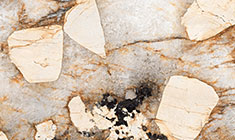
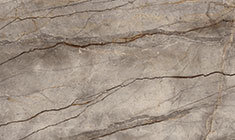
By reducing the visual presence of joints, the wall appears more seamless and the fireplace can be part of a single architectural volume. Large-format tiles also enhance the material’s graphics, especially when veins, shades, or textures become central elements of the project. In this way, the cladding can create a direct connection between architecture and furniture, allowing the fireplace wall to interact with floors, furniture, and other surfaces in the living space. The Grande collection, with slabs up to 160×320 cm, offers several material interpretations designed for projects in which continuity and visual impact play an important role.

How to coordinate the fireplace cladding with walls and flooring
The relationship between fireplace, wall coverings, and floors can be constructed for continuity or contrast, depending on the desired effect.
Using the same material on the fireplace and the surrounding wall allows, for example, the creation of a true architectural backdrop, in which the hearth integrates without interrupting the surface. More nuanced continuity can instead be achieved by choosing the same aesthetic family with different formats, shades, or finishes, thus maintaining a common language without making the space too uniform.
The fireplace can also be designed as a contrasting element, choosing a surface capable of standing out from the wall or floor in terms of color, graphics, or materiality. When the same collection includes solutions suitable for both flooring and cladding, it is also possible to extend the dialogue between surfaces and create a more unified project. This approach is also visible in some Marazzi projects: in the Private Residence Lancashire, for example, the fireplace cladding resumes the material language used in the kitchen area, while in The Edge Family Home the same marble-effect aesthetic helps link different elements of the open space.
Discover all Marazzi collections and find inspiration for designing and cladding your home fireplace.


